How to Build Up Your Walking Without Sore Feet
A new step goal, a job on your feet or a dog that needs longer walks can ask more of your feet than they're used to. Adding to your walking a little at a time gives them a chance to catch up.

The first week of a new walking habit tends to feel wonderful. You take the longer way home or add a lap with the dog, and for a few days your legs feel loose and your head feels clear. Then, around day four or five, the soles of your feet ache by evening, shoes that felt fine in the hallway feel snug by the last mile, and your calves complain on the stairs.
That ache raises a fair question: is it the ordinary cost of getting going, or a sign that you asked for too much, too soon? Walking is one of the gentlest ways to start exercising, which also makes it easy to start too big, since nothing about it feels like training. A jump from a short stroll to a long one doesn't register as a jump until the evening, when your feet send in their account.
The short answer
Begin with a walk you can finish comfortably, then add a small amount of time every week or two. Make one walk the longer one, keep the pace easy enough to talk and follow harder days with easier ones. Mild muscle tiredness is ordinary when you walk more. Sharp pain in one spot, pain that worsens with each walk, or pain that lingers at rest is a reason to cut back and ask a healthcare professional. Move gently, stop anything that doesn't feel right, and if you're recovering from an injury or surgery, check with a healthcare professional before you start.
Why a sudden jump in walking is hard on your feet
With every step, your foot takes your body's weight, rolls from heel to toes and pushes off again, and a longer walk repeats that sequence many more times. Muscles respond quickly, which is why tired legs are usually an early sign that you've done more than usual. Bones, tendons and the skin of your soles also adapt to the load they carry, but they seem to do it more gradually than muscle does.
Bone is a clear example. It's living tissue that's constantly broken down and rebuilt, and when the load rises, the rebuilding steps up to meet it, though not overnight. If the load climbs faster than the rebuilding can follow, a bone can become sore and sometimes develop tiny cracks called stress fractures. A sudden increase in activity is among the things most often linked to them, which is one reason to build gradually, and there's more in stress fractures in the foot.
Different situations catch people out in the same way. A long break, a new job on foot, a dog who needs more, a trip full of sightseeing: each raises the load faster than your feet expected. Too much too soon shows up as feet that stay tired into the next morning, a tender patch that wasn't there last week or a hot spot where a seam rubs. It's a mismatch between how quickly the walking grew and how quickly your body could follow.
A build-up routine you can follow
The routine below is a pattern more than a plan: a starting walk, small additions and rest built in. You'll need a way to time your walks, a notebook or a phone note, and shoes and socks you already find comfortable. Start slowly, move gently and stop anything that doesn't feel right. If you're recovering from an injury or surgery, have been inactive for a long time, have balance problems or reduced feeling in your feet, or live with a health condition, check with a healthcare professional before you begin.
Start with a walk you can finish
Choose a length you could repeat tomorrow without dreading it. For many beginners that's five to ten minutes, and for others it's longer; the right start leaves your feet feeling fine the next morning.
Add time in small amounts
When a week feels easy, add a small amount to your walks, such as a couple of minutes. If a week felt hard, repeat it before adding more, and make one walk a week the longer one.
Keep the pace easy
Walk at a pace where you could talk with a friend, and change one thing at a time: more minutes or more speed, not both at once.
Follow a longer walk with an easy day
After your longest walk of the week, take a shorter, slower walk or a day off. Rest leaves bones, tendons and muscles time to keep up with the load.
Look over your feet and shoes
At home, take off your shoes and look at your feet for red patches, hot spots or blisters. Check whether shoes or socks rub anywhere.
Note how your feet feel
Jot down each walk's length and how your feet and legs feel that evening and the next morning. Patterns show up on paper that memory misses.
The size of each step up matters more than its exact number. Beginner schedules often add only a couple of minutes a week, and some use a rule of thumb that keeps each week's increase small. Small changes also give a clear signal: if something hurts after one, you know what changed.

Pace, ground and shoes
Pace is easy to get wrong, because it's tempting to make up for a short walk by walking fast. A common check is the talk test: at a moderate pace you can talk but not sing, a sensible ceiling while you're building up. Hills and stairs raise the load in the same way, and they have their own guide in walking stairs, hills and uneven ground.
The ground matters too, though less clearly than people hope. Some people find softer surfaces, such as a packed dirt path or grass, gentler underfoot than concrete, but the evidence for walking is mixed, and softer ground is often less even, which asks more of the ankles.
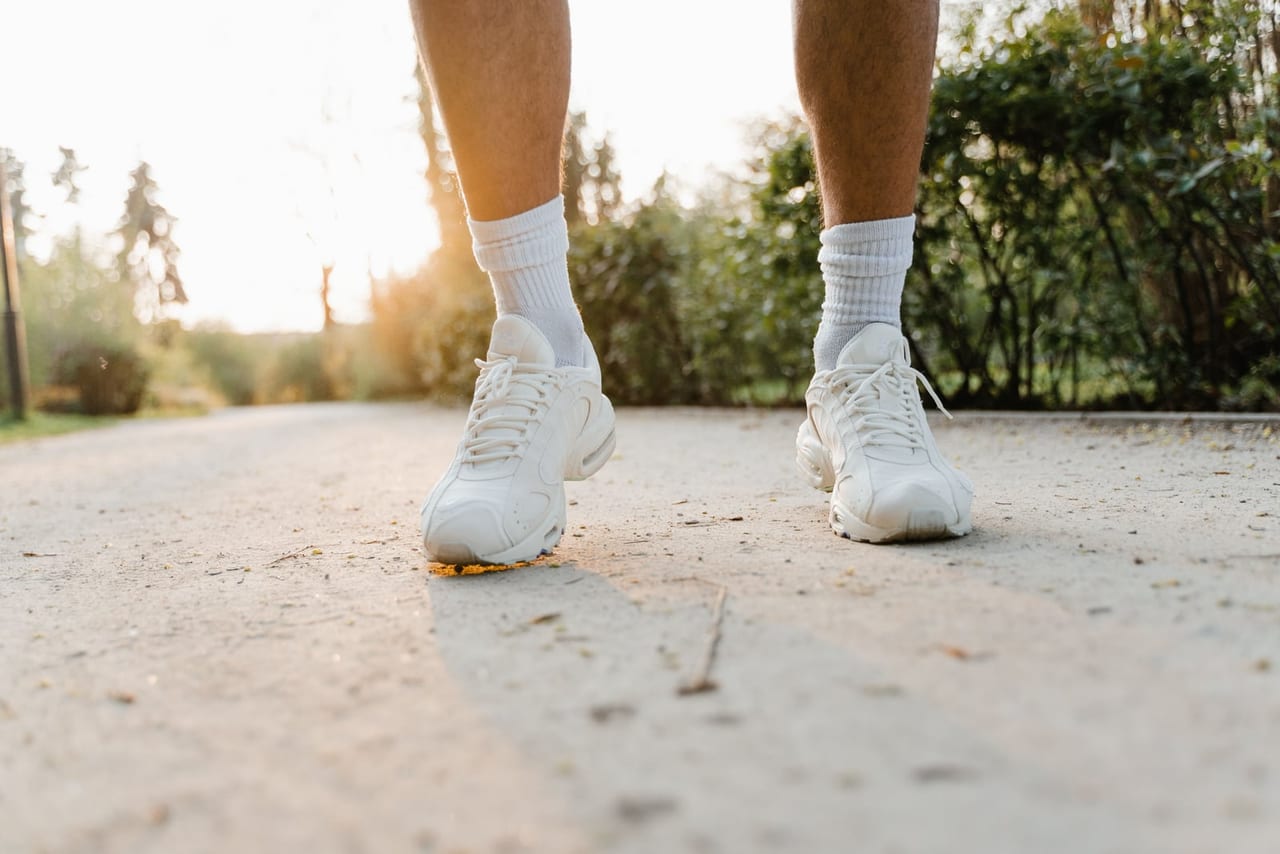
Shoes and socks are the part you control. A longer walk gives any rubbing seam more time to raise a blister, so it's worth checking the fit before the distance goes up, using what to look for in walking shoes.
Rest days and step counts
Rest is part of building up rather than a pause in it. Bone, tendon and muscle are thought to adapt in the recovery between loads, which is why the easy day after a longer walk has a job to do. Many beginner schedules walk on most days rather than every day, and there's no single right pattern, only the sense that harder days shouldn't be stacked end to end. After a cold or a trip, there's no need to restart where you stopped; a shorter walk is a fine place to begin again.
A step counter works better as a mirror than as a target. It shows what you actually do in a week, so you can see what a new job or a longer dog walk adds, and it lets the number rise slowly. A round figure chosen because it sounds good doesn't know how your feet feel on day three. When the two disagree, listen to your feet.
When sore feet may mean something more
Some soreness comes with walking more than you're used to. Muscles in the calves, thighs and soles can feel tired or achy after a longer or brisker walk than usual, typically the next day or the one after. The feeling tends to fade over a few days and to spread across a whole muscle rather than sit in one point.
Pay closer attention when the pain looks different: sharp rather than achy, in one spot you can point to with a finger, worse with each walk instead of easing within a few days, or still there at rest or at night. Swelling, bruising or warmth around the spot adds to the reason. These aren't signs to push through or to work out at home from a description; they're reasons to cut your walking back and ask.
Questions people ask
How much should I add to my walking each week?
A small amount. Beginner schedules often add a couple of minutes a week, and some start with only five to ten minutes a day. If a week felt hard, repeating it before adding more is a common choice, and the morning after a walk tells you more than any schedule does.
Should I walk every day when I'm building up?
Many people walk on most days and include at least one shorter or easier day, though there's no single right pattern. Several short walks can feel easier than one long one, since each stays within what your feet can finish.
What if I have to walk more for work or a trip?
Build in what you can: shoes and socks you already trust, a seat when there's a chance, easier days between the longest ones and a look at your feet at night. A few extra walks in the weeks before a trip give your feet some practice.
The bottom line
Your enthusiasm, and sometimes your breathing, can be ready for more walking long before your feet are. Feet seem to keep a schedule of their own, set by bone, tendon and skin that adapt gradually, and they answer to patience far better than willpower. A walk a little shorter than you wanted today leaves room for a longer one later.