Achilles Tendinitis: Why the Back of Your Heel Aches
A tender spot at the back of the heel can turn a flight of stairs into a chore and a familiar walk into something you notice afterward. It's a common kind of soreness, and the reasons behind it make sense once you see them.

It often begins quietly. You walk a little farther than usual or take a hillier route, and the next morning the back of one heel is stiff. A few steps in, it loosens, and you forget about it until evening, when a thumb pressed along the cord above the heel finds a tender spot.
Nothing dramatic happened, which is part of what makes it puzzling. There was no twist and no fall, only a soreness that speaks up in a steady, low voice. Rest it, walk it off, stretch it or leave it alone: it's hard to know which.
The short answer
Achilles tendinitis is soreness and stiffness in the Achilles tendon, the thick cord that joins the calf muscles to the heel bone, usually after repeated strain. The ache tends to sit at the back of the heel or just above it and is often stiffest first thing in the morning. A sudden jump in activity, tight or weak calves and getting older are among the things linked to it.
Day to day, people commonly cut back on whatever sets the ache off, swap in low-impact movement, stretch their calves gently and check that their shoes still cushion the heel. Pain that isn't getting better after a few weeks is worth taking to a healthcare professional, and so is a sudden snap or pop at the back of the ankle.
What the Achilles tendon does, and what tendinitis means
The Achilles tendon is the thick cord you can feel at the back of your ankle, running from the calf to the heel bone. It's the largest tendon in the body, and each time the calf muscles tighten, it passes the pull on to the heel. That's what lifts you onto your toes when you walk, climb stairs, run or jump.
Tendinitis is the name most people know, and it points to an irritated tendon that usually builds from repeated strain rather than one injury. Professionals also use the broader word tendinopathy for tendon pain of this kind, so you may see either word in a report.
It can show up in two places. In one pattern the sore stretch is in the middle of the tendon, a little above the heel, and it tends to affect younger, active people such as runners. In the other it sits where the tendon meets the heel bone, often with a small bony growth called a bone spur, and it can affect people who aren't especially active.
What the soreness tends to feel like
The soreness usually sits along the tendon or just above the heel. It often starts as a mild ache after a run or other exercise and, for some people, grows into a burning or aching pain after longer efforts, stair climbing or sprinting. Mornings tend to bring stiffness that often loosens as you get moving and can return after a long sit.
The tendon may feel tender when pressed, and the area can look a little swollen or feel thicker. Over time, some people notice the ache even at rest. It ranges from a mild ache that settles once you're moving to pain that limits walking.
The Achilles tendon sits at the back of the heel, so soreness there often involves the tendon. Pain under the heel or along the arch usually involves a different structure, the band of tissue along the sole, and that's the territory of plantar fasciitis. If you're not sure where yours sits, a healthcare professional can tell what is going on.
Why the tendon gets overloaded
The simplest way to picture it is a mismatch, with the tendon asked to do more than it's used to. Sudden jumps are the classic example: more distance, more speed, a run of hills, a new surface or a return after a long break. Any of them gives the tendon little time to adjust.
Some of the load sits in the body rather than the calendar. Tight calf muscles are linked to Achilles trouble, and so are weak ones, which fits the way the calf and the tendon work as a pair. Flat feet and extra body weight are linked to extra strain, and the tendon itself weakens with age, so the problem becomes more common as people get older.
Shoes and surfaces belong in the picture too. A pair that has lost its heel cushioning or support, and routes that are hilly or keep changing, are things a professional may ask about. So is any new medicine, since some prescription medicines are linked to tendon problems. None of it makes trouble certain, and why one person gets a sore Achilles and another doesn't isn't fully understood.

Everyday habits for the back of the heel
These five habits are among those most often suggested for a tendon that's been under strain. You need only a wall, something sturdy to hold and shoes you already own. Move slowly and gently, stop anything that doesn't feel right, and if you're recovering from an injury or surgery, check with a healthcare professional first.
Warm up before you pick up the pace
Begin every walk, run or hike at an easy pace for the first few minutes, and save hills and speed for once your calves feel loose.
Stretch your calves gently
Stand facing a wall and step one foot back, knee straight and heel down, then lean in until you feel a mild pull in the calf. Hold about 30 seconds without bouncing and switch legs; many people do this in the morning and after activity. Stop if the back of the heel hurts.
Build up a little at a time
When you add distance, speed, hills or a new surface, raise one gradually rather than all at once, with easier days between the harder ones.
Swap in a low-impact day
When the back of the heel feels sore, many people trade a run or a hilly walk for cycling or swimming and save the harder effort for another day.
Check your shoes
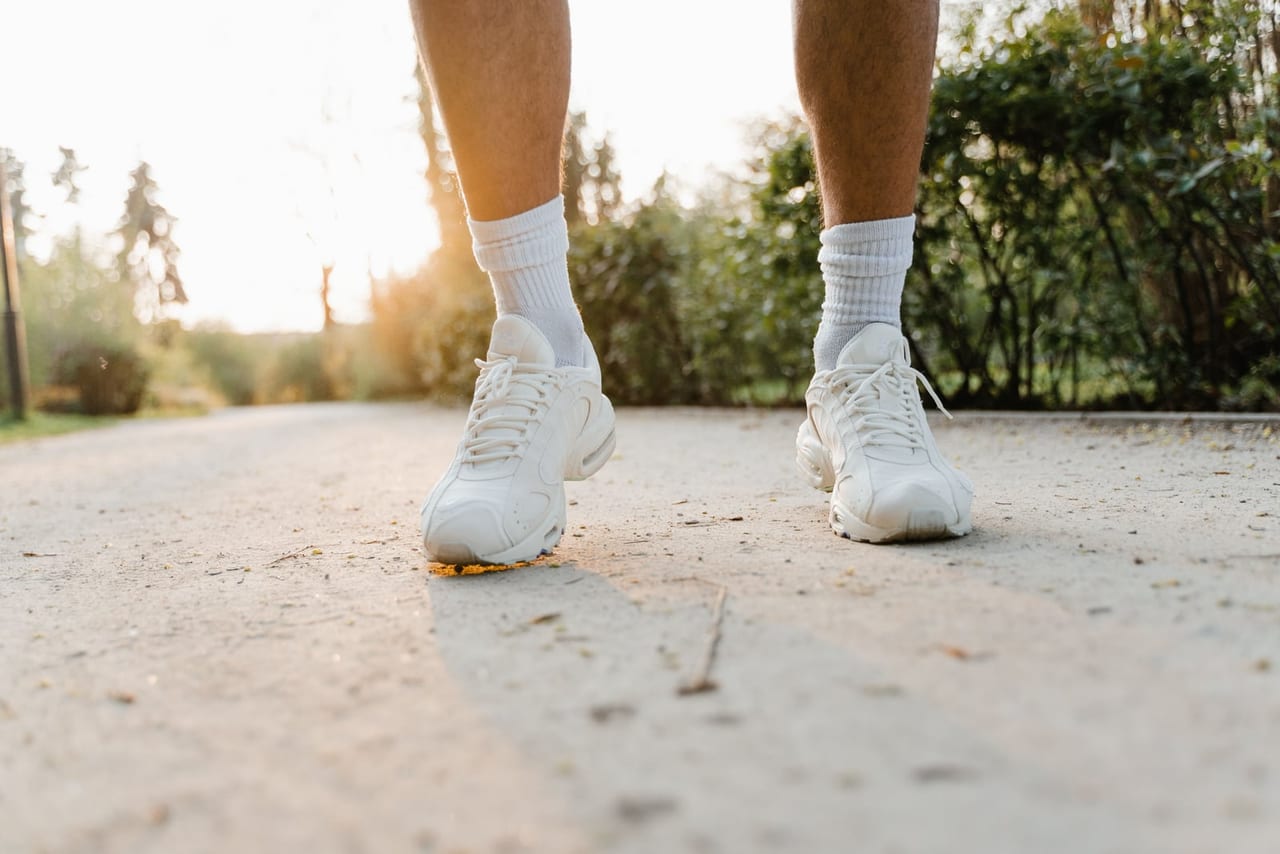
Look for a cushioned heel, good arch support and a heel that stays put without squeezing. A pair whose cushioning has gone flat, or whose soles are worn unevenly, is worth replacing.
Most of these fit into moments you already have, such as a few easy minutes at the door before a walk. The routine in a warm-up for your feet before a walk or run shows one way to loosen up, and how to choose running shoes covers fit and cushioning.
What a healthcare professional may do
A visit usually starts with questions and hands-on checking. A healthcare professional may ask about your activity, shoes and medicines, then press gently along the tendon to find the tender spot and watch how the foot and ankle move. Imaging may follow: an ultrasound or MRI scan can show the tendon itself, while an X-ray shows the heel bone but not tendons.
From there, a professional may talk through options. These can include cutting back on the activity that sets the pain off, different footwear, a small heel lift or custom-made inserts, and a supervised exercise program that works on calf strength. A walking boot for a short time may come up when the pain is severe, and for some people other care or surgery is discussed once months of simpler care haven't been enough. Pushing through pain is rarely suggested, since a tendon that keeps being strained can become more vulnerable to a tear.
When back-of-heel pain may mean something more
A mild ache after an unusually long or hard outing, or some stiffness in the first steps of the morning that loosens as you move, is a familiar pattern for a tendon that's been working. It tends to follow effort and rest, worse after a hard day and quieter after an easy one.
Pay closer attention when the pattern changes. Pain that keeps going through easier weeks, that returns each time you resume your routine or that shows up even at rest deserves a closer look, as does a lump or swelling that keeps growing. A sudden sharp pain or snap at the back of the ankle is in a category of its own and a reason to see a healthcare professional.
Questions people ask
How long does Achilles tendinitis last?
There isn't one answer, because it varies with how severe the soreness is and how long it has been there. It often takes weeks to months, and stubborn cases can run longer. A healthcare professional can look at the whole picture.
Can you keep exercising with a sore Achilles tendon?
Cutting back on the activity that brings the pain on is the usual suggestion, and many people swap in cycling or swimming for a while. Stop anything that brings sharp or growing pain. A healthcare professional can say how much activity suits you.

The bottom line
A sore Achilles tendon is often less about how hard you work than about how fast things changed. Tendons seem to adjust gradually, and most of what people do about the ache comes down to giving the tendon time to catch up with the life it's being asked to lead.